

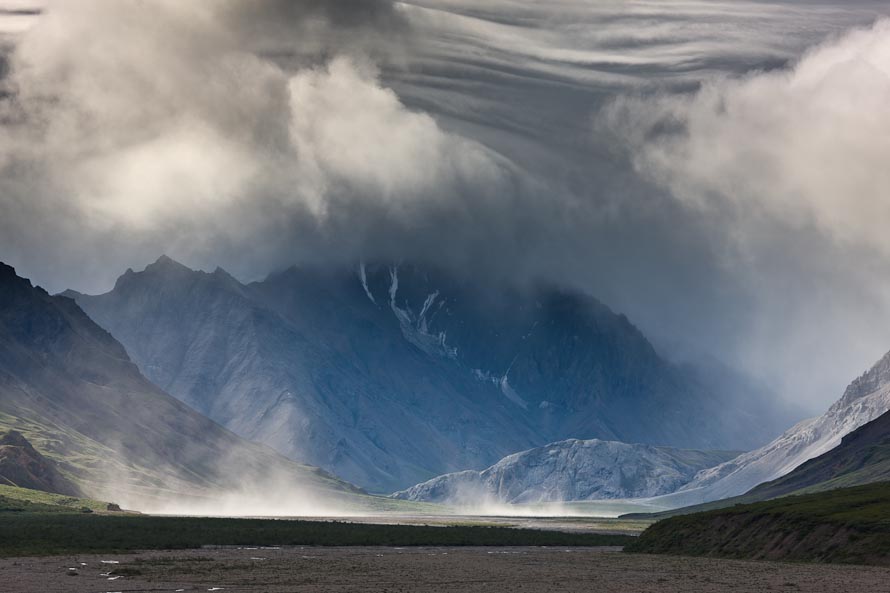
Clouds over the Alaska Range, Denali National Park, Alaska. Canon 1Ds Mark III, 100-400mm f/5.6L IS (180mm), 1/400 sec @ f/6.3, ISO 100
Why do I like the mountains so much? Because they deliver such quickly changing weather. The Alaska range arcs across the south central region of the state and tends to serve as a moisture block forcing the dump of precipitation on its southern side, leaving the interior of the state a more dry climate. This summer in Denali Park, I saw so many fascinating clouds that I think I could do a book just on that subject. This river drainage near the Toklat in Denali park reveals a mixture of low lying clouds, dust clouds from wind, and a dense layering of dark clouds over the mountains. A few cracks in the cloud barrier let in some late morning light to generate some drama. I exposed the scene heavy to the right to capture as much detail in the shadows as possible, then pulled the brightness down on the sky with a split graduated filter in LR3 to reveal the detail in the clouds.
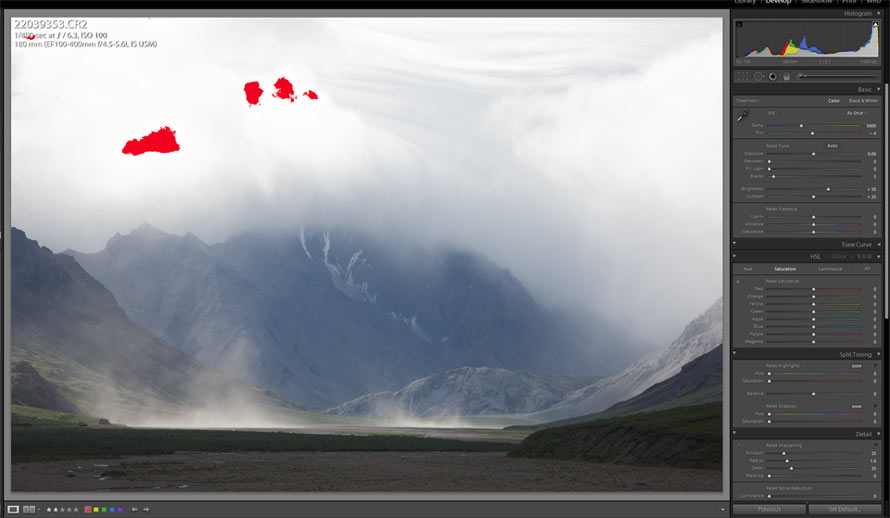
RAW capture exposed to the right to retain detail in the shadows. Sky balanced using the split graduated ND filter in Lightroom


Great illustration of exposing to the right and the use of ND in LR3. I’m really glad I learned a bit of that from you earlier this year, I now see potential for images in scenes that I otherwise might not have photographed previously.
Very pretty! As you know, I will not be sharing any cloud images from my recent Denali trip.
Phil,
Are you using the lens profiles corrections much in LR3? I’ve found them helpful most times, but sometimes not quite on for CA adjustments. I’ve been enjoying your recent Antarctica posts. http://www.oceanlight.com/log/
Ha ha Jon, I do know indeed. As a matter of fact, we have not had a cloud since you were here (in the interior anyway). Things are changing though, leaves are almost gone and the temp was 28 degrees at my office this morning. Where is that blog post from your denali flight?
That is just incredible!!! wow…
First off I like this image a lot!
I have used similar graduated filter methods in Photoshop. I am curious though as to why one would use software after the fact to achieve this effect instead of using an actual GND on your camera in the field? Greater flexibility in the software method?
Michael,
Your question invokes varying opinions and perspectives. I’ll avoid the controversy over field vs. post production use of filtration and jump to my take and the practical reasons behind it. I have used split grads in the field years ago. They work sufficiently, however, I chose to use software when possible to create the same effect because:
1) it is easier
2) it is much faster
3) no plastic or resin goes on the end of expensive camera glass
4) due to speed, I can get shots otherwise not possible with the time necessary to set up the split grad (like the photo above-which was a quickly changing scene that happened real fast)
5) the dynamic range latitude in a RAW file today affords shadow/highlight control making the need for split-grads up to 2 or 3 stops often unnecessary.
6) And finally, the precision accuracy of the grad application is much better and easier in the software. This is particularly true when working with grads during the rain, high wind, or other inclement conditions–which I’ve done in the old film days!
There is more to say on the subject, and field split grads still have a place–in some cases. I know colleagues who still choose to use them. So in the end, for me, it is quality, accuracy and speed that tip the scale.
That is beautiful Patrick – I love those clouds!
I wonder is this the same tool found in Camera RAW with Photoshop CS 5.
Thanks Ron,
Basically yes, the same tool in PS5, although I like the interface of LR3 much better. The workflow speed and efficiency of LR3 over PS or Bridge is immense in my opinion. I know other software has some crossover functionality, but LR3, although not perfect, sings a pretty good tune. I can literally ad a split grad filter in seconds.
Are we living on the same planet?
Mark,
Well the continent division is certainly too far away. Had a great weekend with our mutual friend from the south.
would you elaborate in future postings on the split graduated part of your process? i need to get LR3 i guess. i bet you were thrilled to see that you could indeed recover those fabulous rolling clouds….love the balance of the turbulence!
Sue,
I’ll make a point to discuss that process in a future post. Its quite simple though–using LR3. As for the RAW capture, when seeking to retain as much shadow detail as possible, I expose to the right just to get a highlight warning blinky. At that point, I know the brightness detail will come through even though it looks terribly washed out on the camera LCD screen.
i get it, yes, i do the same on the camera with histogram reading. it is comforting to know that results can be obtained from that kind of a guess, thanks…look forward to the split graduated posts.
Thank you for the response Patrick. I am fairly new to these filters so I am always curious to see what other photographers use as I gradually obtain new equipment. I should probably take a look at lightroom.
Great images! I just stumbled across your website and blog recently and have started making it a habit to go back and read your posts from the beginning. Unfortunately LR3 stopped supporting apples PPC computers so it may take me awhile to catch up in the software department. In the mean time I will continue to learn and be inspired by your photography.
Erik,
Thanks for visiting and expressing appreciation for my photography.
Pat, I just came across your work this Sunday morning. You’ve captured His Majesty through the art of photography, and it was a wonderful time of worship for me. While scanning the images of bears and Polycrome Pass in Denali and your other wonderful work, I teared up with joy and praise knowing it’s such a privilege and doesn’t come by chance! What a wonderful ministry. Thank you for bringing me back to Alaska!!
Thanks Sandy,
I’m pleased to hear you found some meaning in the photographs.