

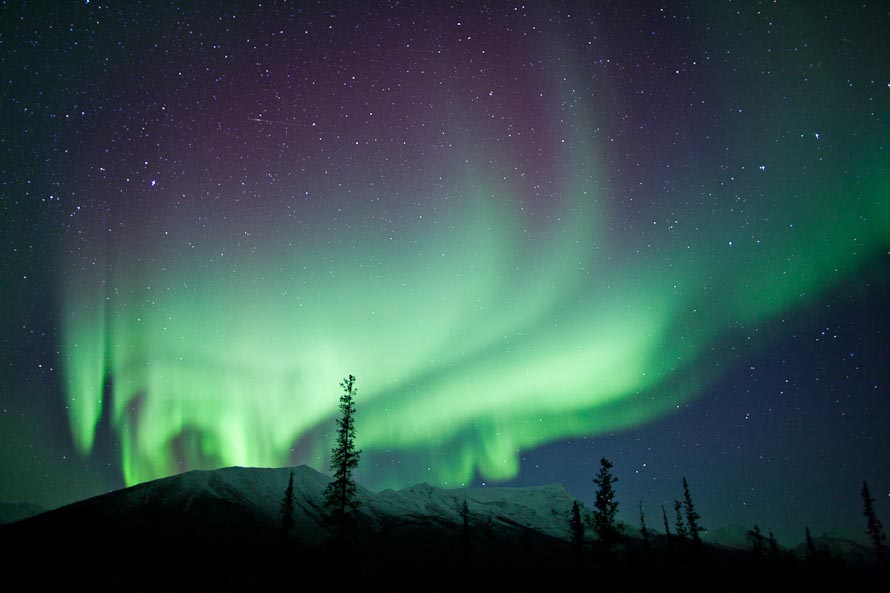
Northern Lights over the Brooks Range, Alaska. Canon 1Ds Mark III, 24mm f/1.4L II, f/1.4 @ 13 seconds, ISO 800.
Before leaving for another 10 day venture in the arctic, here is one photo taken during my previous trip last week, late one evening when the aurora spilled across the sky. It was taken about 2:00am, in the Brooks Range, on a nearly new moon evening. In retrospect I would have shortened the exposure a little, perhaps from 13 seconds to 8 seconds, which would have frozen the shape a tad more, and the brightness of the aurora could have sustained the reduced time. Bumping the exposure from 800 to 1600 would also reduce time, but I’m a slow convert to the 1600 ISO range, although in can produce some amazingly grain free images. I’ll be seeking for more aurora borealis displays on the second photo tour I’m guiding over the next 10 days.


Beautiful shot! What was teh temperature like up there? Is that a meteorite in the top third of the image?
Stunning image, Patrick – I agree you could have shortened the exposure slightly. Will you do the same trips next year?
My guess is that the object in the upper third on the left is a satellite, reflecting sunlight. What was the date, location and time of day?
Nice display. Got to love a fast lens for less time also. I would be afraid of coming back with out of focus images. I have no problem pushing my 5D Mark II to 1600. Great photo.
Mike
I’m impressed 800iso equals a grain free pic. I’m more motivated now to ditch my 5D – yuck. I get grain in the lower half of my histogram at 400!
Eli,
The temps on that night were about 20 degrees, if I remember correctly. And I think I agree with Neal that the object is a satellite.
Neal,
The image was taken on Oct 9, 1:56am, near Wiseman, AK.
Mike, it seems that the 5dII does 1600 a little better than the 1Ds series. Can wait for the 1Ds IV!
Richard,
I think we will do the trips again next year, but will take a few weeks to evaluate.
Steve,
The 5DII is indeed an upgrade in ISO performance. All you need is the cash 🙂