

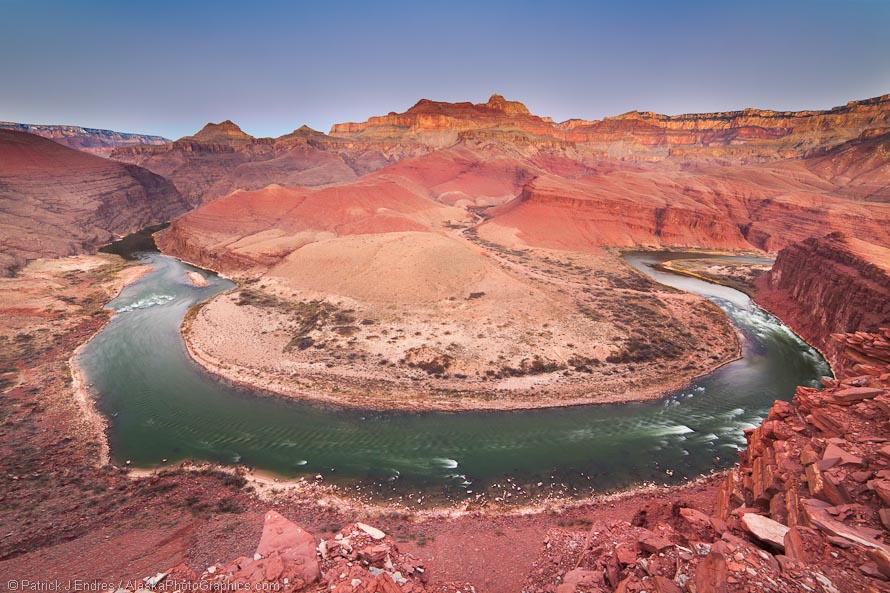
Unkar rapids, Colorado river, Grand Canyon National Park, Arizona. Canon 5D Mark II, Rokinon 14mm f/2.8, 8 sec @ f/16, ISO 100
Unkar Rapids, Grand Canyon National Park, Arizona
There are many situations within the Grand Canyon landscape that require a super wide lens, due to the enclosed and tight nature of the canyon walls, and the sense of space one can convey by grabbing epic turns in the winding river. Such was the case with this view above Unkar Rapids. I hiked up the ridge in the dark one morning about 5pm, and sat with fellow river traveler Mike DeHoff watching the stars, waiting for the light to unfold. I took this shot at nearly 7:00 am, just as the light was about to hit the distant mountains marking the rim of the canyon. The flat lighting revealed the preferred tonality to this scene since morning light was harsh and isolated to a tiny section of the canyon rim. An exposure of 8 seconds gave the surface water a blur. Foreground composition was slightly complicated as moving to the edge of the cliff provoked the appropriate genetic resources of apprehension, although it is hard to tell from the image how steep of a drop off was at my feet.
The Rokinon 14mm ED AS IF lens
Through interaction on my blog, photographer Rodrigo Roesch asked if I had ever used the Rokinon 14mm lens for aurora shooting. I had not, and requested that he send me a RAW file that he captured during one of his ventures. Upon review of that file, I was impressed at the corner and edge sharpness of the lens and decided to try it out for the first time on my trip through the Grand Canyon. While steering away from an in depth lens review, I can say that the lens sharpness is very good, and compares with, if not out performs the 17-40 and 16-35 on the far edges. As a prime lens it clearly has less chromatic aberration, which is not surprising. (note: I’m addressing apertures of f/11 – f/16 in this case, that is, for general daytime landscape use-I have yet to use it aurora myself at f/2.8)
The focus and the aperture ring are manual on the Rokinon lens, and for that reason, the aperture does not show in the camera’s EXIF information. Not a big deal really, and since I almost always choose this lens for wide landscapes with infinity focus, the manual focus is not an issue either. While I prefer canon lenses in general, for a variety of reasons, in this case the Canon lens cost $2,200 and the Rokinon about $400. That is quite a spread, and I felt certainly worth some experimenting.





Hello!
In Spain Rokinon lenses are called Samyang, I also have the 14mm. and I am impressed with their quality and low price. I always had used for night photography and recently during a trip to Norway to capture the Northern Lights use it intensively and the results were satisfactory, also published a small comparison between the 17-40mm, 16-35mm f2.8 and 14mm Nikon mount adapter for Canon thus preserved exif’s and focus confirmation 🙂
Take this opportunity to congratulate you on your work and your blog.
Congratulations!
Thanks for that info Pere
Great shot of Unkar, Patrick! You might like to see my little (1:10) video of running Unkar with our river guides a year ago. http://youtu.be/6pb276NGpAI
Stephen, thanks for sharing the video. It brought back fun memories and a view of Unkar bluffs from below. It was chilly and shady when I went through there.